TC cover
Co-editors-in-chief: Caroline Clason, Chris Derksen, Christian Haas, Christian Hauck, Nanna Bjørnholt Karlsson & Hanna Lee
eISSN: 1994-0424

The Cryosphere (TC) is a not-for-profit international scientific journal dedicated to the publication and discussion of research articles, short communications, and review papers on all aspects of frozen water and frozen ground on Earth and on other planetary bodies.

The main subject areas are ice sheets and glaciers, permafrost, river and lake ice, seasonal snow cover, and sea ice, including remote sensing, numerical modeling, in situ, and laboratory approaches, and studies of the interaction of the cryosphere with the Earth system. Manuscripts with a focus on cryospheric research that include perspectives from social science, humanities, and other disciplines outside the natural sciences are also welcome.

Journal metrics

TC is indexed in the Web of Science, Scopus, Google Scholar, etc. We refrain from displaying the journal metrics prominently on the landing page since citation metrics used in isolation do not describe importance, impact, or quality of a journal. However, these metrics can be found on the journal metrics page.

News

30 Jun 2026 The Norwegian University of Science and Technology partners with Copernicus Publications to support open-access publishing

Copernicus Publications has signed a new institutional agreement with Norwegian University of Science and Technology (NTNU). Please read more.

30 Jun 2026 The Norwegian University of Science and Technology partners with Copernicus Publications to support open-access publishing

Copernicus Publications has signed a new institutional agreement with Norwegian University of Science and Technology (NTNU). Please read more.

07 May 2026 Temporary unavailability of article and preprint PDFs due to technical issues

Since Tuesday, 5 May, 06:30 CET, we have been experiencing technical issues caused by high demand on our systems, which have significantly affected our journal libraries. To maintain platform stability and ensure continued access to critical services, all preprint and journal article PDFs were temporarily restricted, while HTML full-text content and XML files remained available. Since Thursday, 7 May, 08:30 CET, we have made the preprint PDFs available again; however, journal article PDFs remain restricted until the technical issues have been resolved. We apologize for the inconvenience and appreciate your patience as we work to restore full PDF access as quickly as possible. Thank you for your understanding.

07 May 2026 Temporary unavailability of article and preprint PDFs due to technical issues

Since Tuesday, 5 May, 06:30 CET, we have been experiencing technical issues caused by high demand on our systems, which have significantly affected our journal libraries. To maintain platform stability and ensure continued access to critical services, all preprint and journal article PDFs were temporarily restricted, while HTML full-text content and XML files remained available. Since Thursday, 7 May, 08:30 CET, we have made the preprint PDFs available again; however, journal article PDFs remain restricted until the technical issues have been resolved. We apologize for the inconvenience and appreciate your patience as we work to restore full PDF access as quickly as possible. Thank you for your understanding.

30 Apr 2026 Greek mountain snow cover halved in past four decades due to regional warming

The authors' research shows that Greece's highest mountains have lost half of their winter snow over the past four decades. Using a new model that reconstructs daily snow cover from satellite and climate data, they found a rapid and widespread decline driven mainly by rising temperatures. Please read more.

30 Apr 2026 Greek mountain snow cover halved in past four decades due to regional warming

The authors' research shows that Greece's highest mountains have lost half of their winter snow over the past four decades. Using a new model that reconstructs daily snow cover from satellite and climate data, they found a rapid and widespread decline driven mainly by rising temperatures. Please read more.

Recent papers

21 Jul 2026
Investigating the drivers of wintertime Southern Ocean sea-ice leads using random forest algorithms
Umesh Dubey, Sascha Willmes, and Günther Heinemann
The Cryosphere, 20, 4017–4035, https://doi.org/10.5194/tc-20-4017-2026,https://doi.org/10.5194/tc-20-4017-2026, 2026
Short summary
21 Jul 2026
| Highlight paper
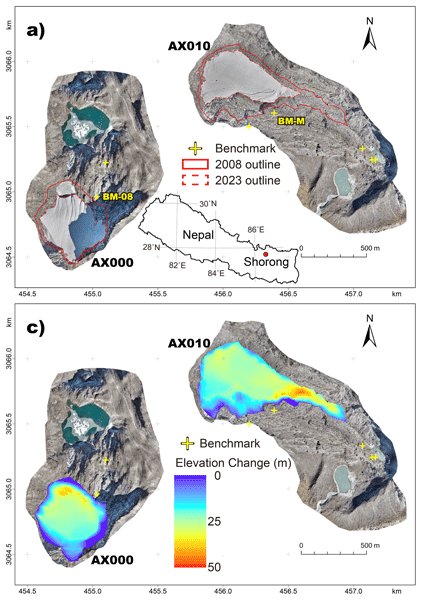
Brief communication: Temperature-driven shrinkage of a disappearing Himalayan glacier
Koji Fujita and Rijan B. Kayastha
The Cryosphere, 20, 4005–4015, https://doi.org/10.5194/tc-20-4005-2026,https://doi.org/10.5194/tc-20-4005-2026, 2026
Short summary Editorial statement
20 Jul 2026
Random forest predictions of tundra snow density elevate Arctic soil temperatures in CLM5.0
Johnny Rutherford, Nick Rutter, Leanne Wake, Georgina Wooley, Julia Boike, and Alex J. Cannon
EGUsphere, https://doi.org/10.5194/egusphere-2026-3363,https://doi.org/10.5194/egusphere-2026-3363, 2026
Preprint under review for TC (discussion: open, 0 comments)
Short summary
20 Jul 2026
Late Holocene stabilization of Conway Ice Ridge
Andrew O. Hoffman, Paul T. Summers, Jenny Suckale, Knut Christianson, Ginny Catania, and Howard Conway
The Cryosphere, 20, 3977–4003, https://doi.org/10.5194/tc-20-3977-2026,https://doi.org/10.5194/tc-20-3977-2026, 2026
Short summary
20 Jul 2026
Local-scale variability in snow chemistry drives distinct microbial communities in Alpine seasonal snowpack
Anastasiia Kosolapova, Romain Castro, Ferran Romero, Catherine Larose, and Ianina Altshuler
The Cryosphere, 20, 3959–3975, https://doi.org/10.5194/tc-20-3959-2026,https://doi.org/10.5194/tc-20-3959-2026, 2026
Short summary

Highlight articles

21 Jul 2026
Brief communication: Temperature-driven shrinkage of a disappearing Himalayan glacier
Koji Fujita and Rijan B. Kayastha
The Cryosphere, 20, 4005–4015, https://doi.org/10.5194/tc-20-4005-2026,https://doi.org/10.5194/tc-20-4005-2026, 2026
Short summary Editorial statement
13 Jul 2026
Contrasting dynamics of lake- and marine-terminating glaciers under same climatic conditions
Florian Vacek, Faezeh M. Nick, Douglas Benn, Maarten P. A. Zwarts, Walter Immerzeel, and Roderik S. W. van de Wal
The Cryosphere, 20, 3827–3845, https://doi.org/10.5194/tc-20-3827-2026,https://doi.org/10.5194/tc-20-3827-2026, 2026
Short summary Editorial statement
01 Jul 2026
Review article: The Foundation-Patuxent-Academy ice stream system, Antarctica
Neil Ross, Rebecca J. Sanderson, Bernd Kulessa, Martin Siegert, Guy J. G. Paxman, Keir A. Nichols, Matthew R. Siegfried, Stewart S. R. Jamieson, Michael J. Bentley, Tom A. Jordan, Christine L. Batchelor, David Small, Olaf Eisen, Kate Winter, Robert G. Bingham, S. Louise Callard, Rachel Carr, Christine F. Dow, Helen A. Fricker, Emily Hill, Benjamin H. Hills, Coen Hofstede, Hafeez Jeofry, Felipe Napoleoni, and Wilson Sauthoff
The Cryosphere, 20, 3705–3737, https://doi.org/10.5194/tc-20-3705-2026,https://doi.org/10.5194/tc-20-3705-2026, 2026
Short summary Editorial statement
29 Jun 2026
Detection and attribution of the role of anthropogenic climate change in industrial-era retreat of Pine Island Glacier
Alexander T. Bradley, David T. Bett, C. Rosie Williams, Robert J. Arthern, Paul R. Holland, James Byrne, Tamsin L. Edwards, and Mira Adhikari
The Cryosphere, 20, 3443–3465, https://doi.org/10.5194/tc-20-3443-2026,https://doi.org/10.5194/tc-20-3443-2026, 2026
Short summary Editorial statement
09 Jun 2026
The influence of ocean waves on Antarctic sea-ice albedo and seasonal melting, and potential coupled physical and biological feedbacks
Robert A. Massom, Phillip A. Reid, Stephen G. Warren, Bonnie Light, Donald K. Perovich, Luke G. Bennetts, Petteri Uotila, Siobhan P. O'Farrell, Michael H. Meylan, Klaus M. Meiners, Pat Wongpan, Alexander D. Fraser, Alessandro Toffoli, Giulio Passerotti, Peter G. Strutton, Sean M. T. Chua, and Melissa Fedrigo
The Cryosphere, 20, 3271–3298, https://doi.org/10.5194/tc-20-3271-2026,https://doi.org/10.5194/tc-20-3271-2026, 2026
Short summary Editorial statement

Notice on APC invoices

In accordance with current European restrictions, Copernicus Publications does not step into business relations with and issue APC invoices (articles processing charges) to Russian and Belarusian institutions. The peer-review process and scientific exchange of our journals including preprint posting is not affected. However, these restrictions require that the first contact (contractual partner of Copernicus) has an affiliation and invoice address outside Russia or Belarus.